Upcoming Sessions
- There are no upcoming sessions scheduled
See All Upcoming Sessions
.png)
After a performance test is completed, the data is used to calculate the fan parameters such as flow, fan static pressure, fan static efficiency fan total pressure, and so on. This self-guided course uses two completely separate avenues to teach the calculation method. In the first, you learn the calculations and their order by navigating your way through the problem, which is presented as a learning puzzle. We have fondly named it "the labyrinth" because as you navigate the challenge, you are exploring the relationships between the variables. In the second approach you approach the calculations in linear order and learn how to program them into a pre-formatted spreadsheet that you can use on future projects. The second approach is optional. Includes pdf course notes that are handy for future reference, and make it easier for you to follow along, especially if English is not your first language. Includes IP - SI spreadsheet calculator for unit conversion. You can leave the course and the system will save your progress for when you come back. Explore or re-visit topics in the sequence you desire. Learning activities and quiz questions keep you engaged in the topics. SI units only. Allow at least 2 or 4 hours in your schedule for completing this course, depending on which parts you choose to do. Instructor: Ron Wroblewski Course length: 2 hours Upon completion, you will earn: 2 Professional Development Hour (PDH) with AMCA completion certificate The AMCA Air Systems Foundations digital badge (issued via Credly) Note: This micro-credential serves as your official entry point and foundational baseline for AMCA’s stackable credentialing pathways. Read more
Rating
Content
Price

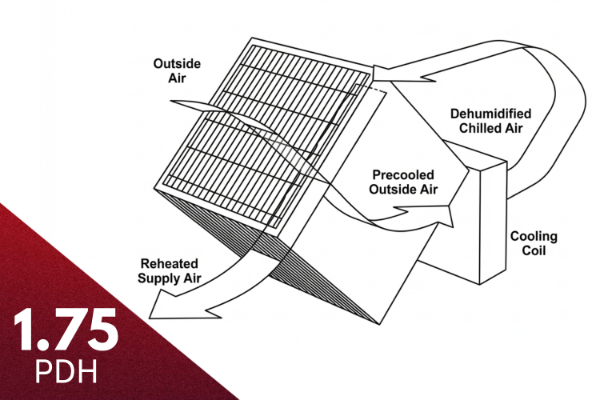
In many fan systems, the amount of electrical energy used to drive the motor is a small fraction of the thermal energy carried by the air or gas. When this thermal energy is wasted, or dumped to atmosphere, it can represent a huge opportunity for energy savings through heat recovery. In new commercial air conditioning applications where there is a high demand for outdoor air, recovering the "cool" energy in the air that is spilled is often immediately cost effective, without any payback period. Industrial thermal processes such as boilers, foundry dust exhaust, and steel mill ovens, (among others) are often great candidates for heat recovery. In this course you will be introduced to 5 different strategies for thermal energy recovery, including the use of: heat wheel, air-to-air, air-to-water, water-to-air, and glycol run-around heat recovery systems. The course also includes a method for estimating the potential energy savings, so you can see if the project has enough value to proceed with the design and implementation. Includes pdf course notes that are handy for future reference, and make it easier for you to follow along, especially if English is not your first language. Includes IP - SI spreadsheet calculator for unit conversion. You can leave the course and the system will save your progress for when you come back. Explore or re-visit topics in the sequence you desire. Learning activities and quiz questions keep you engaged in the topics. SI units only. Allow at least 1 hour 45 minutes in your schedule for completing this course. Instructor: Ron Wroblewski Course length: 1 hour & 45 minutes Upon completion, you will earn: 1.75 Professional Development Hour (PDH) with AMCA completion certificate The AMCA Air Systems Foundations digital badge (issued via Credly) Note: This micro-credential serves as your official entry point and foundational baseline for AMCA’s stackable credentialing pathways. Read more
Rating
Content
Price
.png)
The performance of a fan is defined by the flow, fan pressure, and power draw of the fan. The fan affinity laws (also called the fan laws for short) are a set of inter-related equations that predict the performance of the fan under varying designs and conditions. For example, from a fan applications perspective, some fan laws dictate how the performance of the fan will vary if we change the density, or the rotational speed of the fan. From a fan design perspective, other fan laws can predict the change in performance due to changes in impeller diameter or size. Yet another even predicts the change in the noise generated by the fan. In this self-guided course, you will apply a simplified set of affinity laws to predict fan performance changes due to changes in rotational speed and changes in density compared to catalog conditions. In high-pressure systems (over 3000 Pa or 12 in w.g.) the compressibility factor must be calculated. Usually when the rotational speed or density changes, the compressibility factor also changes. In this course changes to the compressibility factor are fully considered, and a method from AMCA publication 210 for calculating the compressibility factor is presented. Included are .PDF course notes that are handy for future reference, and make it easier for you to follow along, especially if English is not your first language. Includes fan compressibility spreadsheet calculator. Includes IP - SI spreadsheet calculator for unit conversion. You can leave the course and the system will save your progress for when you come back. Explore or re-visit topics in the sequence you desire. Learning activities and quiz questions keep you engaged in the topics. SI units only. Instructor: Ron Wroblewski Course length: 60 minutes PDH credits: 1 Read more
Rating
Content
Price
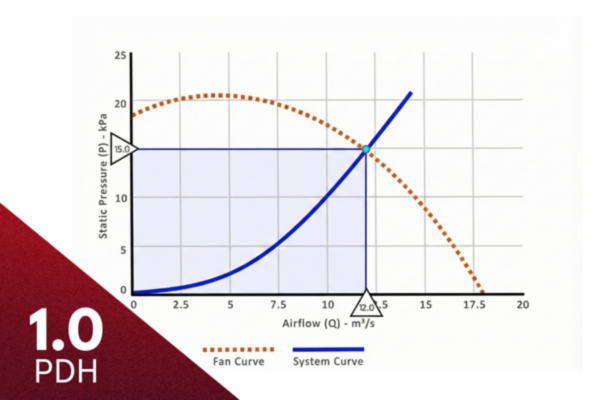
The performance of a fan is defined by the flow, fan pressure, and power draw of the fan. The fan affinity laws (also called the fan laws for short) are a set of inter-related equations that predict the performance of the fan under varying designs and conditions. For example, from a fan applications perspective some fan laws dictate how the performance of the fan will vary if we change the density, or the rotational speed of the fan. From a fan design perspective other fan laws can predict the change in performance due to changes in impeller diameter or size. Yet another will predict the change in the noise generated by the fan. In this introductory self-guided fan applications engineering course, you will apply a simplified set of affinity laws to predict fan performance changes due to changes in rotational speed and changes in density compared to published catalog performance. In this course changes to the compressibility factor are not taken into consideration. See FSO225 Advanced Affinity Laws for high-pressure systems where the compressibility factor cannot be ignored. Includes pdf course notes that are handy for future reference, and make it easier for you to follow along, especially if English is not your first language. Includes IP - SI spreadsheet calculator for unit conversion. You can leave the course and the system will save your progress for when you come back. Explore or re-visit topics in the sequence you desire. Learning activities and quiz questions keep you engaged in the topics. SI units only. Allow at least 45 minutes in your schedule for completing this course. Instructor: Ron Wroblewski Course length: 60 minutes PDH credits: 1 Read more
Rating
Content
Price
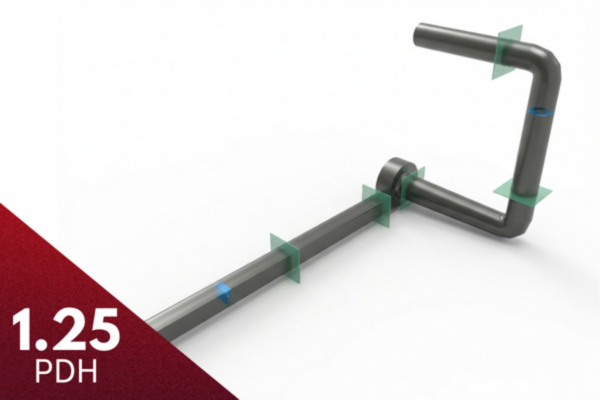
The fan power law defines the fundamental engineering relationship between four key indicators of fan performance: fan flow rate; fan static (or total) pressure, fan power, and fan static (or total) efficiency. In this self-guided course, you will work with the elements of the fan power law equation and explore how they interact. You will also practice calculating the compressibility factor and the fan electrical and mechanical power. Includes pdf course notes that are handy for future reference, and make it easier for you to follow along, especially if English is not your first language. Includes IP - SI spreadsheet calculator for unit conversion. You can leave the course and the system will save your progress for when you come back. Explore or re-visit topics in the sequence you desire. Learning activities and quiz questions keep you engaged in the topics. SI units only. Allow at least 1 hour 15 minutes in your schedule for completing this course. Instructor: Ron Wroblewski Course length: 75 minutes PDH credits: 1.25 Read more
Rating
Content
Price
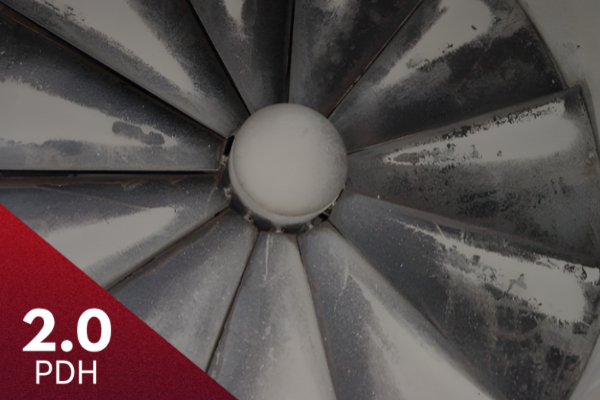
At a given rotational speed and fan pressure, centrifugal fans will develop a constant volume of airflow. Due to uncertainties in the final layout and construction of the ductwork, combined with the prospect of critical or changing process needs, many fans are selected to deliver more pressure and flow than what the industrial process or air-conditioning system actually requires. Some sort of control must then be employed to reduce the airflow to the desired level. In this self-guided course, you will explore common methods used for varying the flow capacity of the fan, such as speed control, outlet dampers, inlet dampers and inlet vane control. Your knowledge of these methods will allow you to accurately estimate and compare the power among the different methods. With this skill you can accurately predict the possible savings of changing to a more efficient method. Includes pdf course notes that are handy for future reference, and make it easier for you to follow along, especially if English is not your first language. Explore or re-visit topics in the sequence you desire. Learning activities and quiz questions keep you engaged in the topics. SI and IP units. Includes IP - SI spreadsheet calculator for unit conversion. Allow at least 2 hours in your schedule for completing this course. You can leave the course and the system will save your progress for when you come back. Instructor: Ron Wroblewski Course length: 2 hours Upon completion, you will earn: 2 Professional Development Hour (PDH) with AMCA completion certificate The AMCA Air Systems Foundations digital badge (issued via Credly) Note: This micro-credential serves as your official entry point and foundational baseline for AMCA’s stackable credentialing pathways. Read more
Rating
Content
Price
Shopping Cart
Your cart is empty