Upcoming Sessions
- There are no upcoming sessions scheduled
See All Upcoming Sessions

This course provides a technical overview of how fans are tested under AMCA 210/211 standards and why those results can differ from field performance. Participants will learn to identify common "performance killers," such as poor aspect ratio inlet boxes and abrupt discharge elbows. The session highlights the physics of airflow and offers practical solutions like turning vanes and no-loss rain stacks to reclaim lost static pressure. Instructor: James Conway PDH: 0 Read more
Rating
Content
Price


This module explores the fundamentals of modern air curtain design, focusing on the critical balance between performance, energy savings, and acoustic comfort. Learners will discover what separates a highly effective air curtain from one that is ultimately turned off by occupants due to loud noise or uncomfortable air blasts. The course examines the three primary barriers air curtains create and details how these systems protect valuable conditioned air to reduce wear on primary HVAC equipment. Instructors: Sami Aslam, Ramin Namvar PDH: 0 Read more
Rating
Content
Price

This course provides a deep dive into the engineering criteria used to select fans that are stable, efficient, and durable. It challenges common industry "rules of thumb," such as fixed outlet velocity limits, in favor of a selection process driven by total efficiency and construction class. Participants will explore the mechanics of "System Effects" (the impact of ductwork and neighboring fans) and learn how to avoid common pitfalls when integrating accessories like filters and Variable Frequency Drives (VFDs). Instructor: Carlos Luis Ribeiro dos Santos Junior PDH: 0 Read more
Rating
Content
Price

This case study examines the forensic analysis and emergency resolution of a primary ventilation fan failure in an underground mine. When critical fan blades began cracking within a month of commissioning, engineers used Finite Element Analysis (FEA) and Computational Fluid Dynamics (CFD) to prove that the root cause was not a manufacturing defect, but a "system effect" caused by the mine's unique tunnel geometry. The session details how a collaborative "run-and-repair" strategy maintained mine production while a permanent, high-stiffness rotor solution was engineered and installed. Instructor: Geoff Sheard, DSc PDH: 0 Read more
Rating
Content
Price

This session examines the efficiency and reliability gains achieved by replacing legacy belt-driven fans with modern EC fan arrays. You will learn how to leverage permanent magnet technology and redundancy to reduce energy consumption and maintenance costs without the need for full system replacement. Instructor: Ricardo Ayarzagoitia Arredondo PDH: 0 Read more
Rating
Content
Price
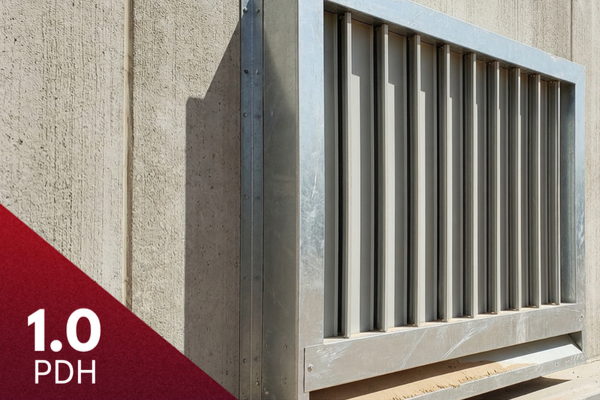
For building owners in Persian Gulf countries, sand storms have long been a fact of life and a threat to HVAC equipment. For this reason, there is growing global attention on the quantity of sand that moves through the louvers installed on building facades and casements of equipment penthouses and enclosures. But a great help has been introduced in this struggle against sand penetration, and that is the introduction of louvers specifically designed, tested and certified to reject sand. This presentation will cover the subject and assist engineers, architects, and specifiers in learning more about this important topic. This webinar was originally broadcast on February 24, 2021. Speakers: Ed Rizk, Abhishek Chhabra Length: 60 minutes Upon completion, you will earn: 1 Professional Development Hour (PDH) with AMCA completion certificate The AMCA Air Systems Foundations digital badge (issued via Credly) Note: This micro-credential serves as your official entry point and foundational baseline for AMCA’s stackable credentialing pathways. Read more
Rating
Content
Price
Shopping Cart
Your cart is empty